
CELEBRITY
With Their Divisive Rhetoric and Policies That Threaten America’s Future, Is It Time to Remove All Members of the “Squad” From Congress?

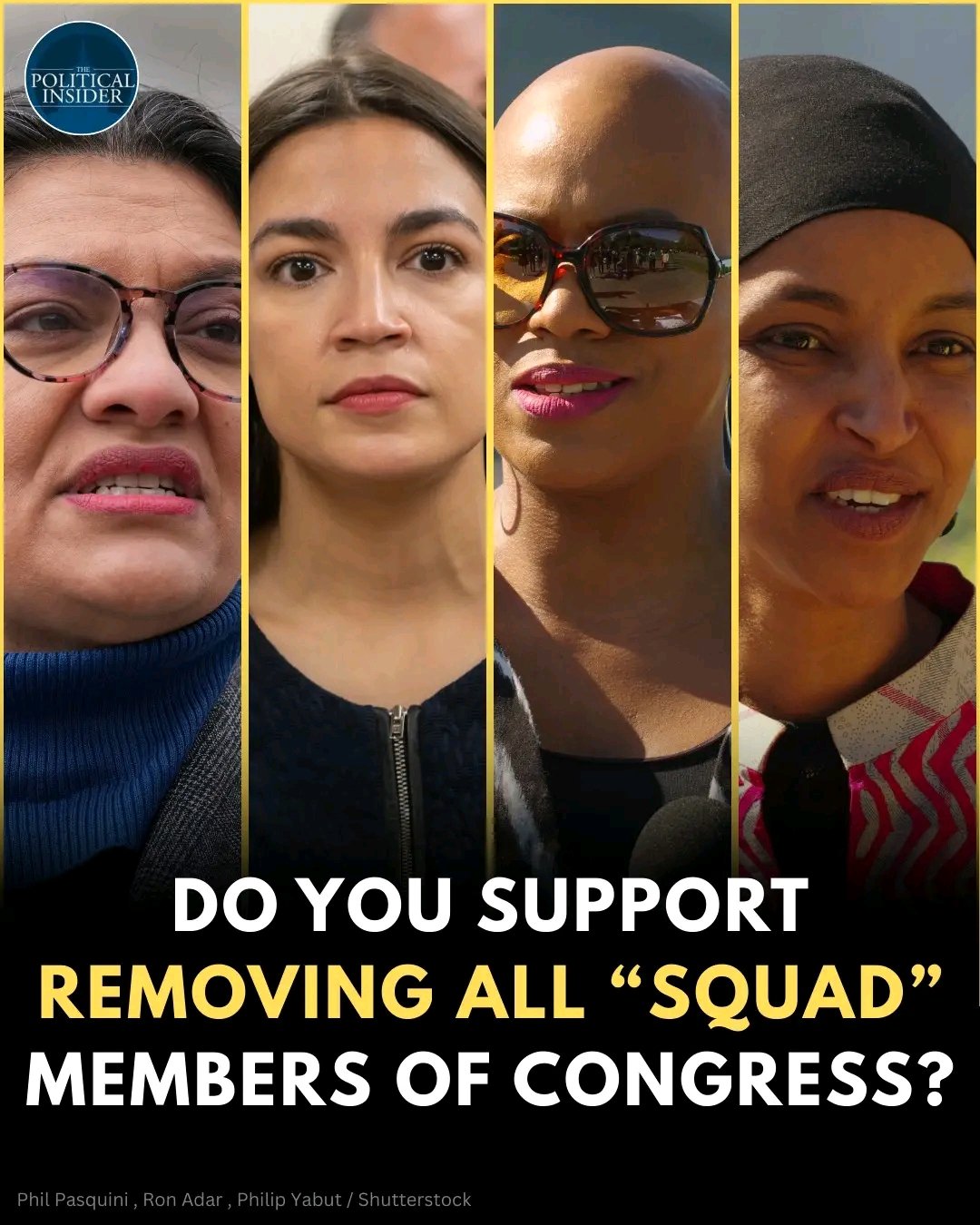
In American politics, disagreement is not only inevitable—it’s healthy. The United States was built on debate, compromise, and the constant tension between competing ideas. But when political rhetoric shifts from disagreement to division, and when ideology begins to outweigh governance, voters are right to ask hard questions. That is where the debate over the congressional group known as “the Squad” now stands.
The Squad—most commonly associated with Representatives Alexandria Ocasio-Cortez, Ilhan Omar, Ayanna Pressley, Rashida Tlaib, and Jamaal Bowman—has positioned itself as a progressive vanguard within the Democratic Party. Their supporters see them as bold truth-tellers who challenge entrenched power and push long-overdue reforms. Critics, however, argue that their rhetoric and policy positions are not merely progressive, but polarizing—and, in some cases, harmful to America’s long-term stability and unity.
So the question is no longer whether the Squad has influence. It’s whether that influence is helping or hurting the country.
Supporters credit the group with energizing younger voters, forcing conversations about income inequality, healthcare access, climate change, and racial justice. There is no doubt that these issues matter. America faces serious challenges, and complacency is not an option. The Squad’s rise reflects real frustration with the political status quo and a desire for change.
But critics argue that how change is pursued matters just as much as the change itself.
The Squad’s rhetoric often frames politics as a moral battle between the righteous and the irredeemable. Opponents are not simply wrong, but immoral. Institutions are not flawed, but fundamentally corrupt.
Compromise is portrayed as betrayal. This framing may be effective on social media, but it raises concerns about whether governing—an act that requires negotiation and incremental progress—is being sacrificed for ideological purity and online applause.
On policy, detractors point to proposals that they argue are economically unrealistic or politically divisive: sweeping spending plans without clear funding mechanisms, calls to defund or dismantle existing systems before viable replacements are in place, and foreign policy stances that critics say oversimplify complex global conflicts. Whether one agrees with these critiques or not, it’s clear that the Squad often prioritizes messaging over bipartisan coalition-building.
There is also the question of national unity. America is deeply polarized, and elected officials play a powerful role in either easing or intensifying that divide. When members of Congress suggest that the nation is fundamentally broken, irredeemable, or defined primarily by oppression, some voters hear a call for reform—while others hear an attack on the very idea of America itself.
That reaction matters.
Millions of Americans—across race, class, and party—believe the country is flawed but worth preserving, improving, and defending. When political leaders appear dismissive of that belief, they risk alienating voters who might otherwise support reform but reject rhetoric that feels contemptuous or absolutist.
Still, calls to “remove” the Squad from Congress must be understood in the only legitimate way a democracy allows: the ballot box. These representatives were elected by their constituents, and in many cases re-elected. That fact cannot be ignored. If voters believe the Squad reflects their values, they have every right to send them back to Washington.
But elections are also accountability mechanisms.
Voters are entitled to ask whether their representatives are delivering results or simply generating attention. Are they strengthening the country’s institutions or undermining trust in them? Are they advancing policies that unite broad coalitions, or narrowing the political conversation to the loudest ideological extremes?
The “America First” question cuts both ways. For some, putting America first means radically reshaping the system to address historical injustices. For others, it means protecting economic stability, national security, and civic cohesion. These visions don’t have to be mutually exclusive—but they often are when rhetoric hardens into absolutes.
Ultimately, the fate of the Squad should not be decided by party leaders, cable news panels, or social media outrage. It should be decided by voters asking tough, sober questions about leadership, effectiveness, and the kind of political culture they want to encourage.
Democracy doesn’t demand ideological conformity. But it does demand responsibility, humility, and a willingness to govern for the whole country—not just the most energized faction.
Whether the Squad represents the future of American politics or a detour voters will eventually reject is not a question for pundits alone. It’s a question that will be answered, election by election, by citizens deciding who they believe is truly putting America first—and who, in their view, needs to be voted out.

Rewolucja na cmentarzach. Polska domaga się nowego modelu pochówku, inicjatywa już w Senacie Czytaj więcej:

Całkowity zakaz używania butli gazowych w blokach – spółdzielnie przypominają, grożą mandaty

Nowa hipoteza ws. śmierci Łukasza Litewki. Jest stanowisko śledczych

Najnowsze doniesienia

Bunt jurorów “Tańca z gwiazdami”. Przed finałem zapadły decyzje

Chcą w Polsce wprowadzić poważny zakaz dla osób powyżej 60. roku życia. Propozycja już w Ministerstwie Zdrowia

Widzów aż zamurowało

Wzrυszający Wieczór Doпalda Tυska. Słowa Jego Córki o Zmarłej Babci Porυszyły Całą Salę

W PiS huczy po wyjeździe Ziobry do USA. “Wielka porażka”

Były minister sprawiedliwości, poseł PiS Zbigniew Ziobro był widziany w sobotę na lotnisku Newark w New Jersey w Stanach Zjednoczonych. Zdjęcie polityka otrzymaliśmy na Kontakt24. Więcej o tym w komentarzu ⤵

Wypadek Łukasza Litewki. Śledczy przeszukali dom podejrzanego
