
CELEBRITY
The Supreme Court on Friday ruled that President Donald Trump violated federal law when he unilaterally imposed sweeping tariffs across the globe, a striking loss for the White House on an issue that has been central to the president’s foreign policy and economic agenda.

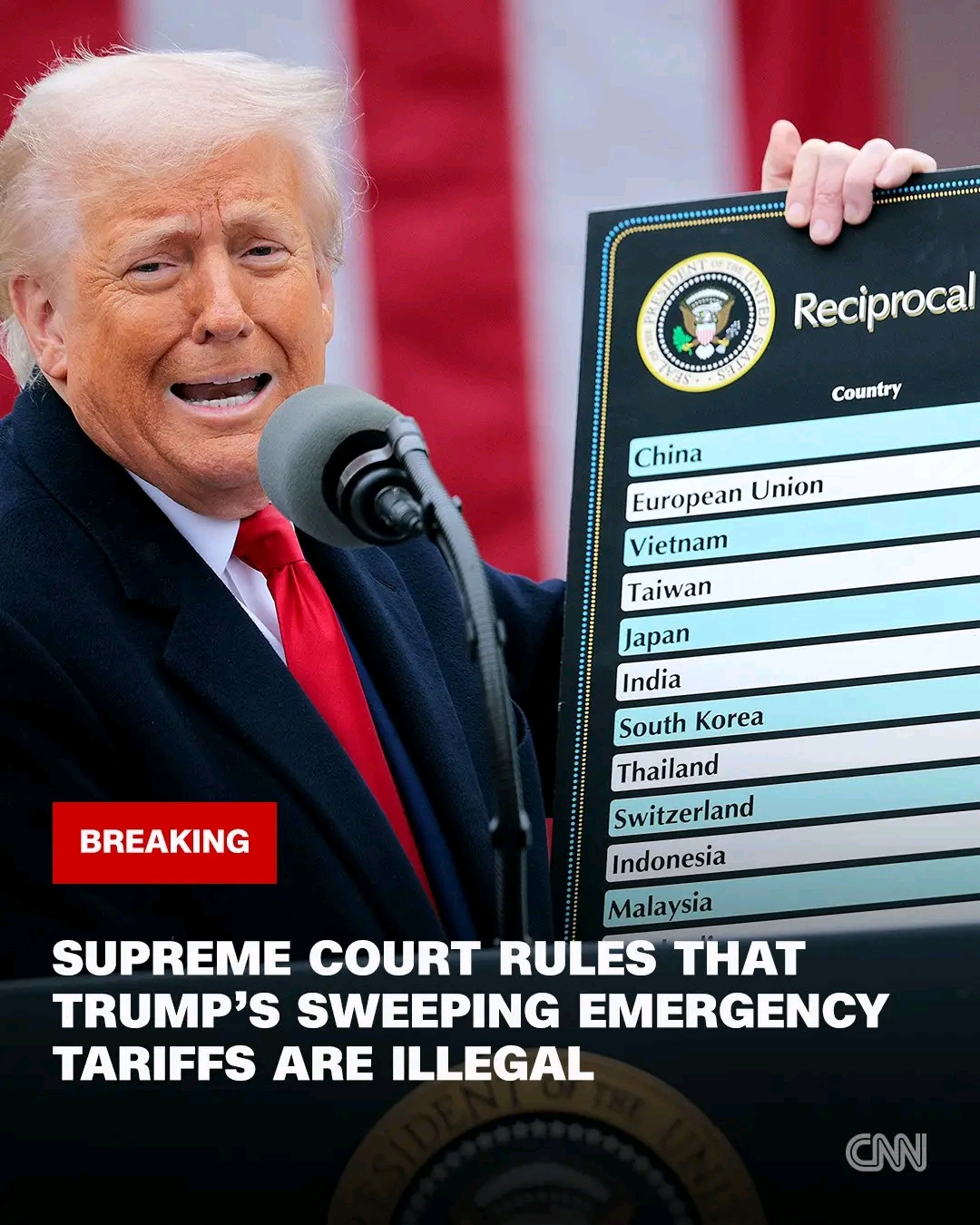
The Supreme Court on Friday ruled that President Donald Trump violated federal law when he unilaterally imposed sweeping tariffs across the globe, a striking loss for the White House on an issue that has been central to the president’s foreign policy and economic agenda.
The decision is arguably the most important loss the second Trump administration has sustained at the conservative Supreme Court, which last year repeatedly sided with the president in a series of emergency rulings on immigration, the firing of the leaders of independent agencies and deep cuts to government spending.
Chief Justice John Roberts wrote the majority opinion and the court agreed 6-3 that the tariffs exceeded the law. The court, however, did not say what should happen to the more than $130 billion in tariffs that has already been collected.
“The president asserts the extraordinary power to unilaterally impose tariffs of unlimited amount, duration, and scope,” Roberts wrote for the court. “In light of the breadth, history, and constitutional context of that asserted authority, he must identify clear congressional authorization to exercise it.”
The emergency authority Trump attempted to rely on, the court said, “falls short.”
Trump called the ruling “a disgrace” while hosting the White House breakfast with governors this morning, according to two people familiar with his comments.
The president and Justice Department officials had framed the dispute in existential terms for the country, telling the justices that “with tariffs, we are a rich nation” but that without them, “we are a poor nation.” A group of small businesses who challenged the duties similarly warned that Trump’s position represented a “breathtaking assertion of power” to effectively levy a tax without oversight from Congress.
Justices Amy Coney Barrett and Neil Gorsuch joined with Roberts and the three liberal justices in the majority. Justices Clarence Thomas, Samuel Alito and Brett Kavanaugh dissented.
In his opinion, Roberts brushed aside an argument from the administration that the president had power to use tariffs to regulate commerce. That was an issue that came up during the oral arguments last year as Trump suggested the president had inherent authority to issue the tariffs.
“When Congress grants the power to impose tariffs, it does so clearly and with careful constraints,” Roberts wrote. “It did neither here.”
“We claim no special competence in matters of economics or foreign affairs,” Roberts wrote. “We claim only, as we must, the limited role assigned to us by Article III of the Constitution. Fulfilling that role, we hold that IEEPA does not authorize the president to impose tariffs.”
No clarity on returning money
The 6-3 majority offered no clarity on the specific practical question of what to do with the money the administration has already collected through Trump’s tariffs. The issue of refunds has loomed large over the case, with Trump administration officials saying that potential repayments could have devastating consequences for the US economy.
As of December 14, the federal government had collected $134 billion in revenue from the tariffs being challenged from over 301,000 different importers, according to United States Customs and Border Protection data as well as a recent filing submitted by the agency to the US Court of International Trade.
That question will likely need to be sorted out by lower courts.
In his dissent, Justice Brett Kavanaugh noted that the court said “nothing today about whether, and if so how, the government should go about returning the billions of dollars that it has collected from importers.”
The issue of refunds has loomed large over the case, with Trump administration officials saying that potential repayments could have devastating consequences for the US economy.
“That process is likely to be a ‘mess,’” Kavanaugh wrote.
Even though the Supreme Court has already ruled in dozens of cases involving the second Trump administration, those all involved emergency applications; this was the first Trump-related case to which the Court gave full review – and it’s an overwhelming loss for Trump on both the specific legal question and the more general ability to broadly use statutes like IEEPA,” said Steve Vladeck, CNN Supreme Court analyst and professor at Georgetown University Law Center.
“What that underscores is that, for as controversial as the court’s grants of emergency relief to the Trump administration have been over the past 13 months, the court is still willing to assert itself when these cases reach the merits – something that we’re likely to see again later this term in the birthright citizenship and Lisa Cook cases.”
Most significant case on US economy in years
The case was the most significant involving the American economy to reach the Supreme Court in years, challenging the legality of Trump’s “Liberation Day” tariffs, as well as duties he imposed on imports from China, Mexico and Canada. At stake were tens of billions of dollars in revenue the government has already collected.
The so-called “reciprocal” tariffs raised duties as high as 50% on key trading partners, including India and Brazil, and as high as 145% on China in 2025.
Trump has relied on a 1970s-era emergency law, the International Emergency Economic Powers Act, or IEEPA, to levy the import duties at issue in the case. That law allows a president to “regulate … importation” during emergencies. The administration argued the word plainly includes the power to impose tariffs, but the businesses noted that the words “tariff” or “duty” never appear in the law.
That raised a series of difficult questions for the Supreme Court itself, which in case after case involving controversial policies from former President Joe Biden, ruled that an administration cannot take certain executive actions unilaterally without explicit authorization from Congress. That is particularly true, the court repeatedly ruled, when policies involve “major” political or economic questions.
In 2023, for instance, the conservative majority relied on the “major questions doctrine” to block Biden’s student loan forgiveness plan. A year earlier, the court stopped Biden’s vaccine and testing requirement for 84 million Americans, concluding that Congress never explicitly gave the government the power to demand those measures during the Covid-19 pandemic. Even some conservatives said the same logic should apply when it came to Trump’s tariffs.
Trump offered several counter-arguments, most notably that the tariffs implicate foreign affairs, where courts have traditionally referred to the executive branch.
The president has other more established authorities to levy tariffs without input from Congress. But each of those come with strings attached, such as time limits, that would make it harder for Trump to pursue his on-again-off-again strategy of raising and then lowering barriers as a negotiating tactic.
Another provision of law, for instance, clearly allows a president to raise tariffs — but only up to 15% for a maximum of 150 days. Another authority gives the president the power to impose higher tariffs for national security reasons. It can only be used to target specific industries and requires an investigation by the Commerce Department.
Every lower court that has reviewed Trump’s emergency tariffs found they violated federal law, though for different reasons. In one case, led by a New York-based wine importer called V.O.S. Selections, the US Court of International Trade concluded in May that IEEPA didn’t authorize Trump’s emergency duties. That decision was affirmed months later by an appeals court in Washington, DC.
In a separate case, an Illinois-based educational toy company, Learning Resources, sued in a federal district court in Washington, which also ruled against Trump. The case quickly went to the Supreme Court, leapfrogging the DC Circuit.
The courts in both cases put their rulings on hold temporarily, allowing the administration to continue to collect the tariffs while the appeals played out.
A significant question looming over the arguments was whether all businesses would be entitled to tariff payment refunds if the justices rule against the Trump administration’s use of emergency powers to impose tariffs.
The filing was in response to a group of importers, including Costco, requesting a preliminary injunction to prevent CBP from finalizing their tariff payments, a process formally known as liquidation. The importers argued that it was imperative for their payments to be unliquidated to get refunds down the road. Their request for a preliminary injunction was denied, however.
The three-panel judge explained that their verdict was supported by the administration’s promise to refund IEEPA tariff payments, if it came down to it, even if entries were liquidated. However, the administration has stated that it would likely be a laborious process.
Justice Elena Kagan wrote a concurrence, joined by the two other liberals, to rebuff some of the reasoning that the three conservative justices ruling against Trump put forward for blocking the tariffs.
She specifically took aim at their use of a judicial doctrine known as “major questions,” which says that if Congress is giving the president the power to take an action with major economic or political consequence, it must use specific legislative language saying that it is doing so. The conservative court repeatedly relied on the major questions doctrine to shoot down major policies enacted by the Biden administration, including his efforts to forgive student loans.
Kagan has in the past criticized the conservative majority’s use of the major questions doctrines to halt executive actions on environmental regulations. Likewise, she was wary of using that tool to strike down Trump’s tariffs, even though she agreed with the decision to do so.
“The use of a clear-statement rule here is unnecessary because ordinary principles of statutory interpretation lead to the same result,” she wrote. ” It is not just that the Government’s arguments fail to satisfy an especially strict test; it is that they fail to satisfy the normal one.”
She said that the normal tools of statutory interpretation pointed to the ruling against tariffs, because the relevant law gives the President the emergency authority to “regulate” the importation of goods and nothing in the definition of that word “naturally refers to levying taxes”
For that and other reasons laid out in her concurrence, “straight-up statutory construction resolves this case for me,” Kagan wrote. ” I need no major-questions thumb on the interpretive scales.”

Konflikt z Iranem znów odbije się na Polakach. Trudno uwierzyć, co teraz podrożeje

Iga Świątek od kilku dni przebywa na Majorce, gdzie znajduje czas nie tylko na treningi pod okiem nowego szkoleniowca, ale też wypoczynek. Była liderka rankingu WTA w Hiszpanii nie jest sama. Wiadomo, na kogo może liczyć w tym nie najłatwiejszym dla niej czasie. 🟥 Link w komentarzu👇

Donald Tusk potępił tragiczną śmierć 7-letniej Amelki. „Nie spełni już swoich marzeń”

Klamka zapadła, Nawrocki podpisał. Seniorzy aż podskoczą z radości

Powoływali się na wpływy w Kancelarii Prezydenta. Trzy osoby z zarzutami

O uwagę poprosił szczególnie prezydenta RP 🚨🚨

Zaskakujące wieści, takiego zwrotu nikt się nie spodziewał 😱

Takie będzie lato w 2026 roku. Czegoś takiego dawno nie było

Dla wielu to szok 😱

Był chudy, jak NITECZKA! 🤯

Anna Popek musi zmierzyć się z nowymi wyzwaniami po zakończeniu programu w TV Republika. Jakie zmiany czekają dziennikarkę?
