
CELEBRITY
Trump credits tariffs for hundreds of billions gained with ‘virtually no inflation,’ touts security

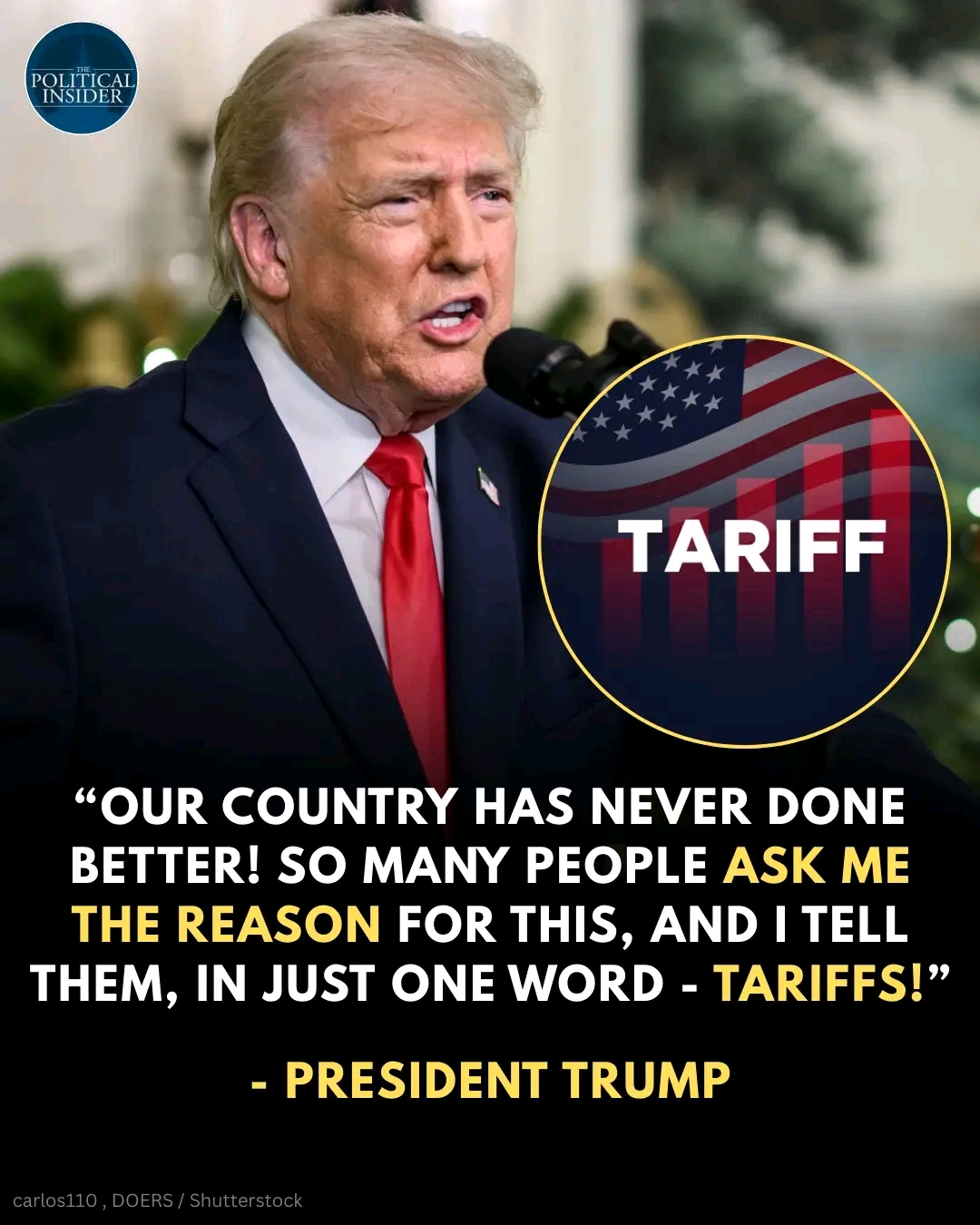
Trump’s Tariff Policy Fuels Historic Economic Growth and Strengthens National Security
In a powerful display of American economic prowess, President Trump credited his strong tariff policies for bringing in hundreds of billions of dollars into U.S. coffers with minimal inflation, all while bolstering national security. Trump’s bold stance against unfair trade practices has not only secured the American economy but also reshaped the global trade landscape. This victory comes at a time when the U.S. and Taiwan have reached a monumental trade agreement that will reshape semiconductor manufacturing and enhance U.S. supply chains, proving that Trump’s policies are the key to a prosperous, self-reliant America.
President Donald Trump credited tariffs for what he called historic economic gains, claiming Thursday that the U.S. has taken in hundreds of billions of dollars with virtually no inflation while strengthening national security.
“Great Financial Numbers were released today,” Trump wrote on Truth Social. “Our Country has never done better! So many people ask me the reason for this, and I tell them, in just one word – TARIFFS!
“We’ve taken in Hundreds of Billions of Dollars, with virtually No Inflation, and our National Security has never been as strong as it is today,” he added. “GOD BLESS THE U.S.A.”
Trump’s post came the same day the United States and Taiwan reached a major trade agreement aimed at reshoring semiconductor manufacturing and strengthening U.S. supply chains, underscoring the president’s long-standing argument that tariffs can be used as leverage to rebuild domestic industry.
Under the agreement, Taiwanese semiconductor and technology firms will commit at least $250 billion in direct U.S. investment to advance “America First trade and investment,” along with an additional $250 billion in credit guarantees to support supply chain expansion across the U.S., according to the Department of Commerce.
U.S. and Taiwanese officials said the deal is designed to reverse decades of offshoring that reduced America’s share of global semiconductor manufacturing from 37% in 1990 to less than 10% by 2024, a decline that has raised economic and national security concerns in Washington.
Future U.S. semiconductor tariffs will prioritize Taiwanese companies that build manufacturing operations in the U.S., allowing duty-free imports tied directly to expanded domestic production capacity.
Officials said the structure is intended to reward companies that invest in American workers and factories while discouraging reliance on overseas production.
The agreement also calls for Taiwan to facilitate U.S. investment in several critical industries, including semiconductors, artificial intelligence, defense technology, telecommunications and biotechnology, sectors viewed as vital to both economic competitiveness and national security.
The investment is expected to expand market access for U.S. companies, deepen technological cooperation with Taiwan and strengthen U.S. leadership in critical and emerging industries.
Trump has long argued that tariffs protect American workers, reduce dependence on foreign adversaries and give the U.S. leverage in trade negotiations. While critics have warned tariffs could raise consumer prices, Trump has repeatedly rejected that claim, pointing to economic data he says shows strong growth with limited inflation.
The Taiwan deal signals that tariffs are likely to remain a central pillar of Trump’s broader trade strategy as his administration pushes to rebuild domestic manufacturing and secure critical supply chains.

ROYAL SHOCKER: Meghan Markle Drops a Stunning Ultimatum to King Charles — And the Palace Isn’t Ready 😳👑

Kościół w Polsce przygotowuje się na wypadek konfliktu. Jest gotowy na najgorszy scenariusz

Kryzys będzie tylko się nasilał. To może być wyjątkowo trudne lato dla branży lotniczej

Ludzie byli przerażeni 😱

Prezydent Karol Nawrocki podjął dwie kluczowe inicjatywy dla polskiej wsi. Co zawiera specjalny list do premiera Tuska?

Ale przystojniak! 😍

— Zostanę tu na długo. Pamiętajcie, że Real Madryt to klub moich marzeń — powiedział Vinicius Junior. Ma zarabiać ogromne pieniądze. 🟥 Link w komentarzu👇

“Umowa była taka, żeby ‘nie cisnąć’ na maksa, to nie odpuścił i 150 kg na ławce pękło!” – chwalił prezydenta Pudzianowski

To najgorsze miejsca w samolocie. Koniecznie ich unikaj lecąc na urlop
